
6 Magical Japanese Techniques to Unlock the Mind”
“Within each of us lies a secret library… not of books, but of memories. What if you could conjure knowledge at will, whisper formulas into the wind, and remember anything—like casting spells from a hidden scroll? Welcome to the enchanted world of Japanese memory techniques—a land where ancient wisdom meets modern study magic.”
Whether you’re a student preparing for exams or a parent helping your child navigate the forest of facts and formulas, these six timeless Japanese methods are your map, compass, and magic wand.

🌸 1. The Memory Palace — “Omoide no Shiro”
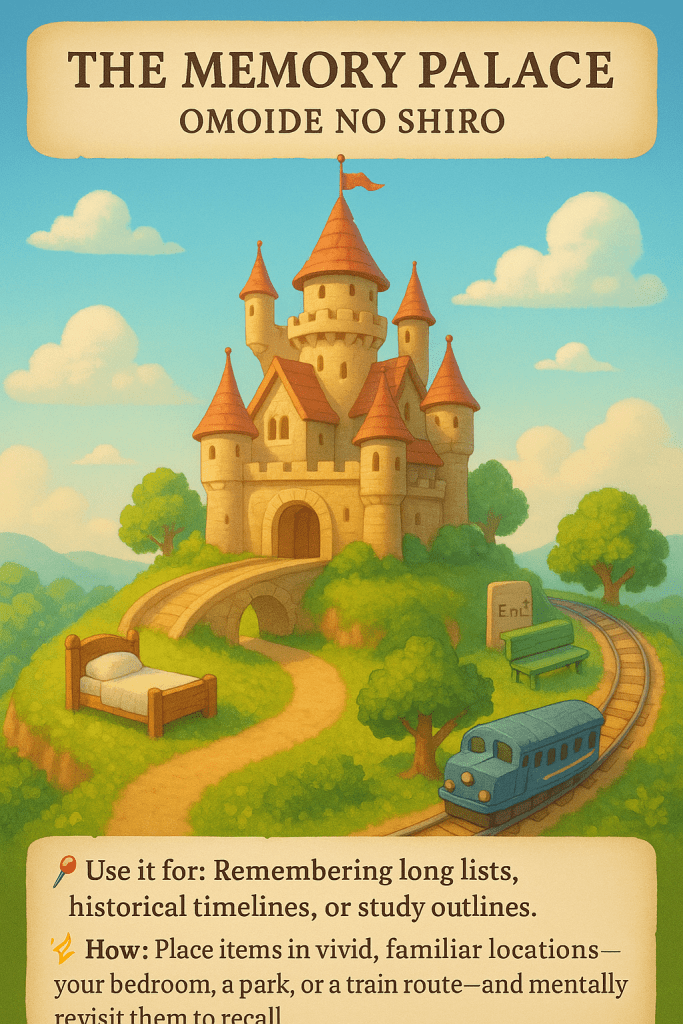
Imagine walking through a castle built entirely from your own memories. Each room stores a piece of knowledge—a date, a formula, a fact. This is the Method of Loci, known in Japan as Omoide no Shiro (Castle of Memories).
📌 Use it for: Remembering long lists, historical timelines, or study outlines.
🪄 How: Place items in vivid, familiar locations—your bedroom, a park, or a train route—and mentally revisit them to recall.
🎎 2. The Art of Chunking — “Kumiwake no Gijutsu”
Japanese culture often emphasizes elegant simplicity—just like chunking. Break information into small, logical clusters. Like origami, folded perfectly.
📌 Use it for: Breaking down phone numbers, vocabulary, or steps in a math process.
🪄 How: Don’t learn “1234567890.” Learn “123 – 456 – 7890.” Easy, right?
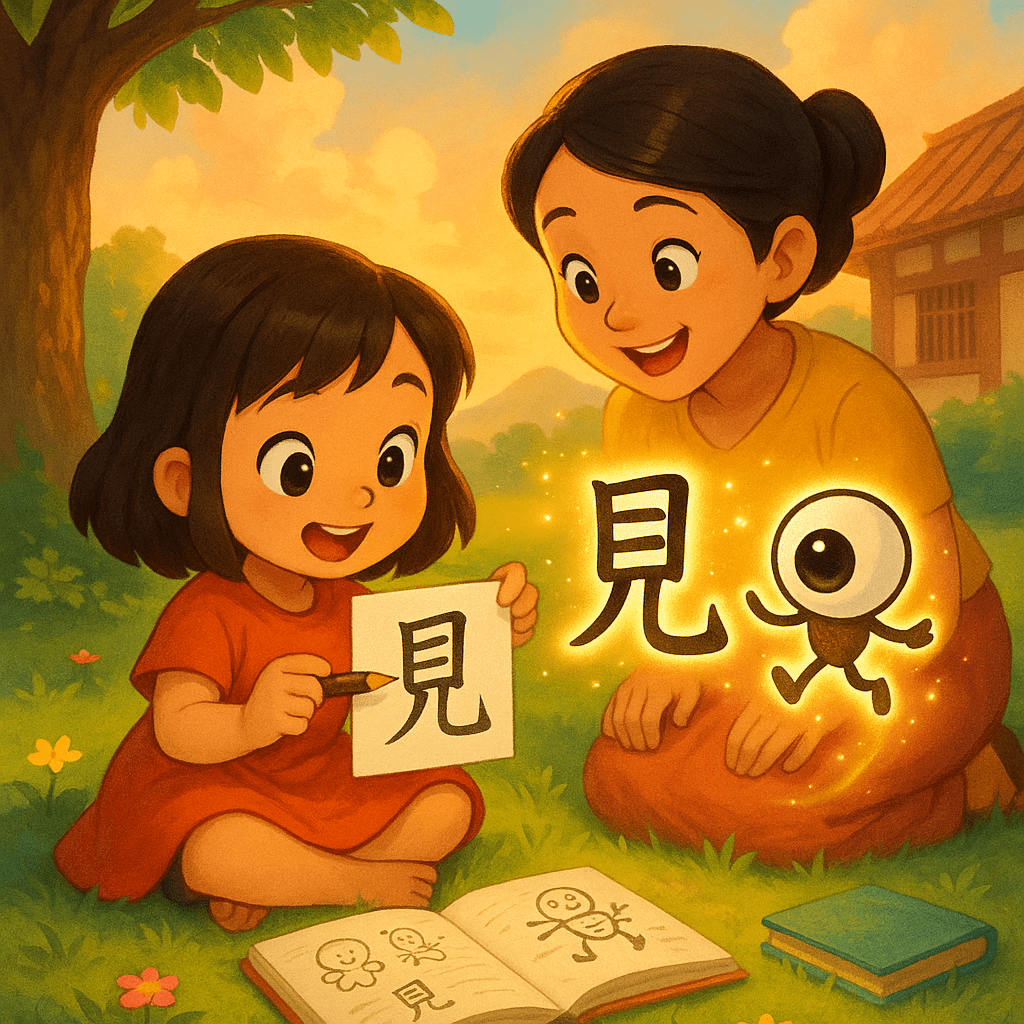
🖌️ 3. Kanji Mnemonics — “Kakikata no Mahō” (The Writing Spell)
Kanji (Chinese characters in Japanese writing) are complex—so learners turn them into visual stories. Picture 見 (mi = see) as “an eye on legs walking to see the world.”
📌 Use it for: Languages, complex symbols, or tricky terminology.
🪄 How: Make a silly or vivid picture in your mind for each item.
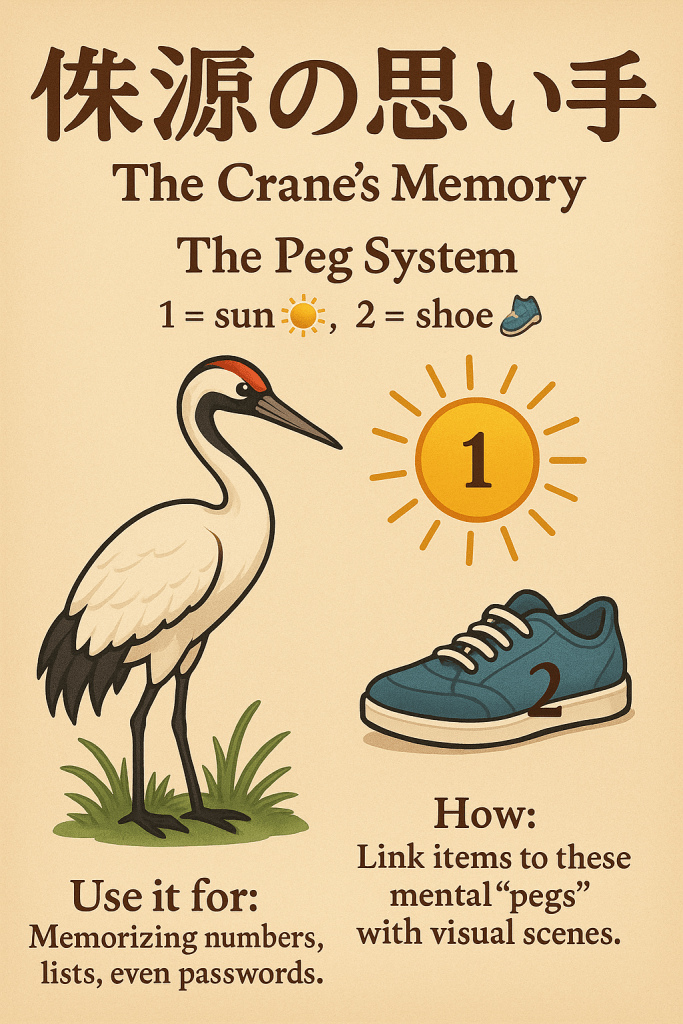
🔗 4. The Peg System — “Tsuru no Omoide” (The Crane’s Memory)
In Japan, the crane symbolizes long life and memory. The Peg System helps you remember things by connecting numbers to vivid images: 1 = sun ☀️, 2 = shoe 👟.
📌 Use it for: Memorizing numbers, lists, even passwords.
🪄 How: Link items to these mental “pegs” with visual scenes.
🎨 5. Kana Storytelling — “Kotoba no Monogatari” (Word Stories)
Japanese students use story weaving to remember vocabulary. Turn your study material into a strange tale. The weirder, the better.
📌 Use it for: Vocabulary, speeches, essays.
🪄 How: To remember “apple, pen, book,” picture a pen stuck in an apple writing its memoir on a flying book!
🧠 6. The Major System — “Sūji no Jutsu” (The Art of Numbers)
This is true memory sorcery. Turn numbers into consonants, then into words or names. Example: 34 = M + R → “mirror.” Now you’ll remember 34 by picturing your reflection.
📌 Use it for: Long numbers, dates, PINs.
🪄 How: Learn the basic number-to-sound code, and invent clever words.
🌟 Bonus Spell: Spaced Repetition — “Kurikaeshi no Mahō” (The Magic of Repetition)
Revisit the same material over a few days—not all at once. Your memory strengthens every time you return to it, like forging a katana with heat and patience.
📌 Use it for: Everything.
🪄 How: Use flashcards (like Anki) or calendar reviews.
🌱 For Students
Think of your brain as a bonsai tree. These techniques are your tools—trimming, shaping, guiding growth with precision and care. Study doesn’t have to be boring. With imagination, it becomes an art.
👨👩👧 For Parents
Support your child by turning study time into storytime. Help them “walk” their memory palaces, invent wild mnemonics together, or rehearse peg games at dinner. Memory becomes stronger when shared with joy.
🏮 Final Thought
These Japanese memory techniques are not just tricks—they’re gentle mental arts, passed through generations like origami patterns or tea ceremonies. With practice, they can transform your study into a dance of remembrance.
“You don’t need a magic wand to learn… just the right spellbook. And now, it’s in your hands.”
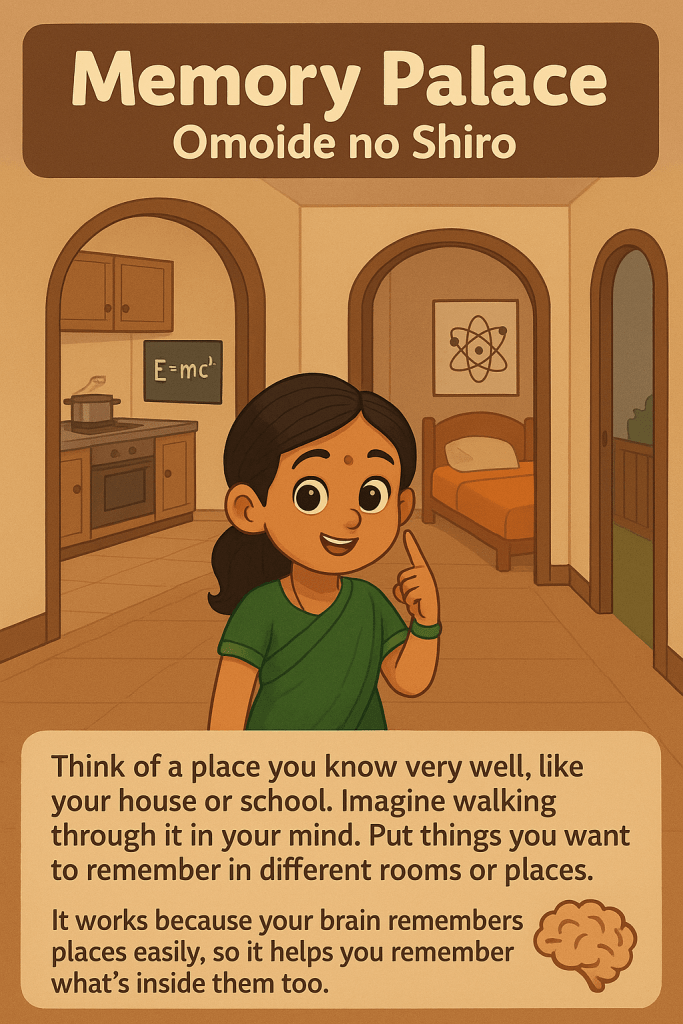
1. Memory Palace (Omoide no Shiro)
How to use it:
- Think of a place you know very well, like your house or school.
- Imagine walking through it in your mind.
- Put things you want to remember in different rooms or places.
- Example: Put a math formula in your kitchen, a science fact in your bedroom.
- When you need to remember, “walk” through the place in your mind.
🧠 It works because your brain remembers places easily, so it helps you remember what’s inside them too.
🎲 2. Chunking (Kumiwake no Gijutsu)
How to use it:
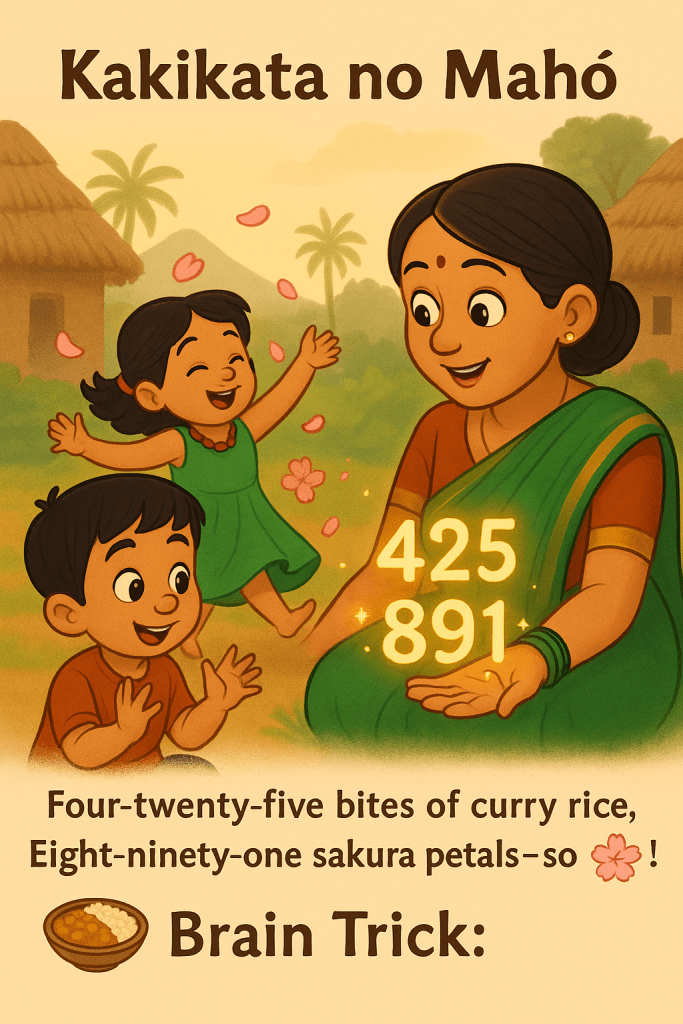
- Break big things into smaller parts.
- Example: Instead of trying to remember “425891”, split it into “425” and “891”.
- Use it for numbers, facts, or even spelling.
🧠 It works because it’s easier for your brain to remember small groups than one long string.

🎨 3. Mnemonics (Kakikata no Mahō)
How to use it:
- Make funny or creative pictures or stories in your mind.
- Example: To remember that the Japanese word “sakura” means cherry blossom, picture a soccer ball rolling through pink flowers.
- Use rhymes, songs, or silly images that make you laugh or smile.
🧠 It works because your brain remembers fun and weird things better than boring ones.
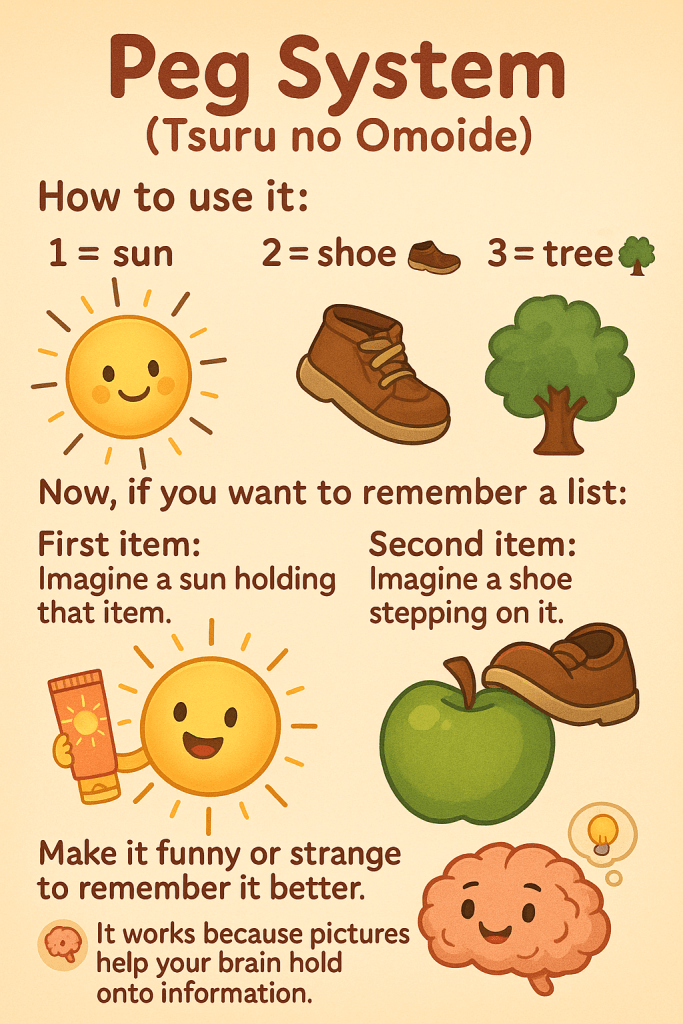
🪁 4. Peg System (Tsuru no Omoide)
How to use it:
- Give each number a picture. Example:
- 1 = sun ☀️
- 2 = shoe 👟
- 3 = tree 🌳
- Now, if you want to remember a list:
- First item: Imagine a sun holding that item.
- Second item: Imagine a shoe stepping on it.
- Make it funny or strange to remember it better.
🧠 It works because pictures help your brain hold onto information.
📚 5. Story Method (Kotoba no Monogatari)
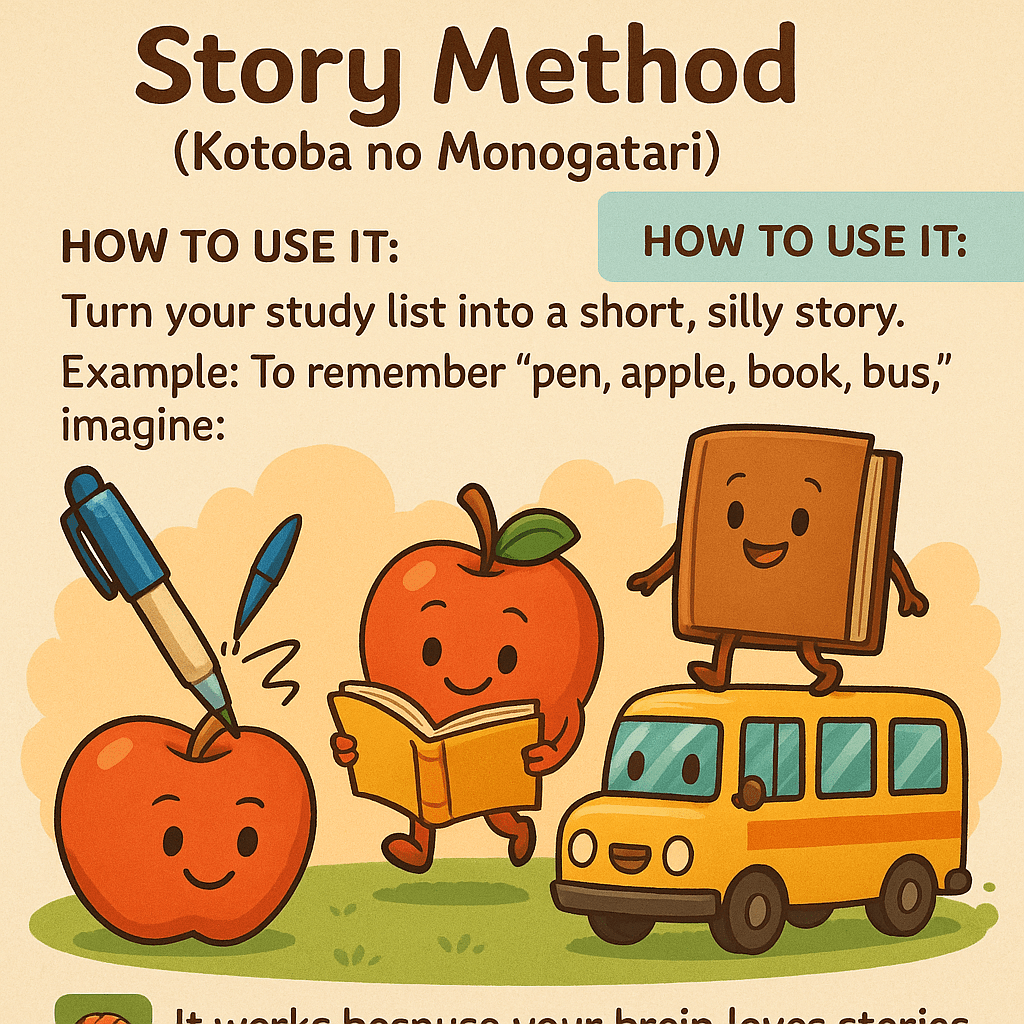
How to use it:
- Turn your study list into a short, silly story.
- Example: To remember “pen, apple, book, bus,” imagine:
“A pen writes on an apple, the apple reads a book, and the book rides a bus!”
- Example: To remember “pen, apple, book, bus,” imagine:
🧠 It works because your brain loves stories, especially fun or strange ones.
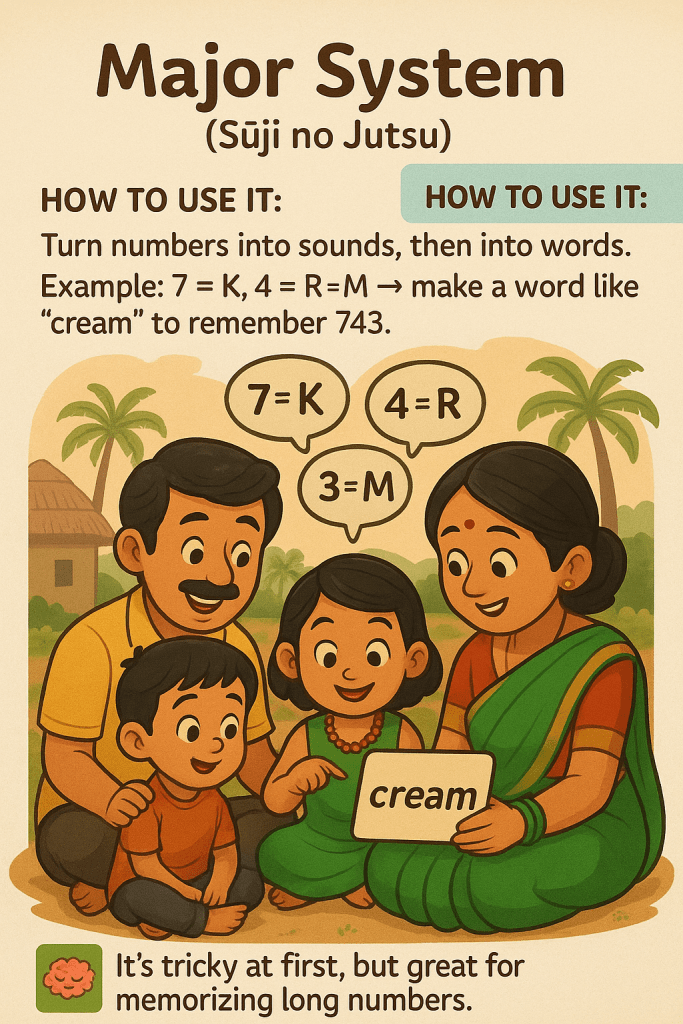
🔢 6. Major System (Sūji no Jutsu)
How to use it:
- Turn numbers into sounds, then into words. Example:
- 7 = K, 4 = R, 3 = M → make a word like “cream” to remember 743.
- It’s tricky at first, but great for memorizing long numbers.
🧠 It works because turning numbers into words makes them easier to remember.
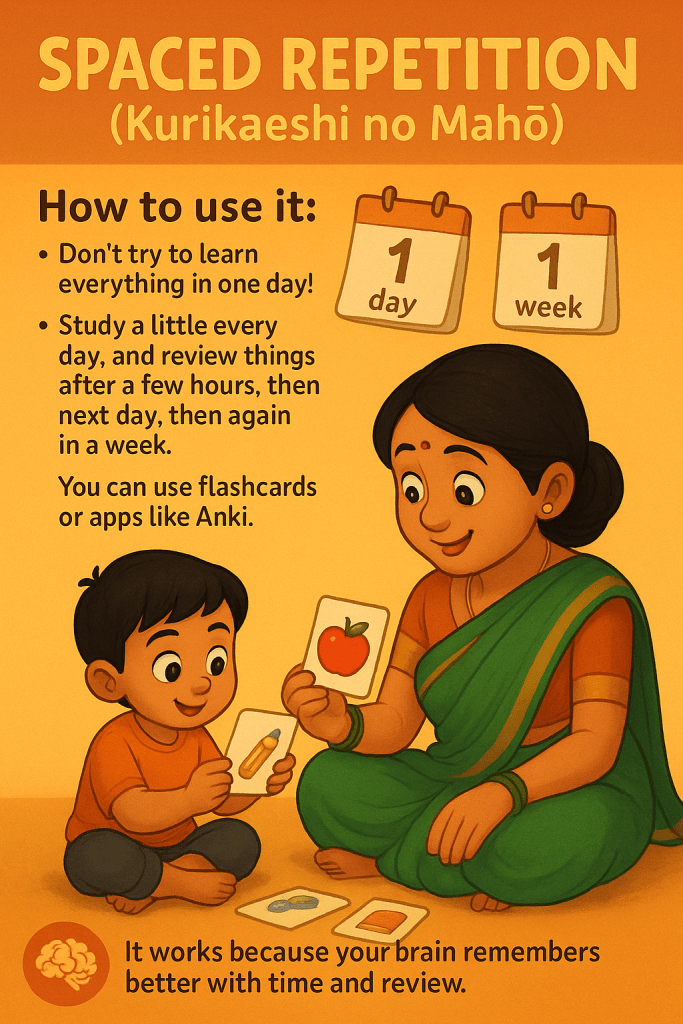
🔁 Bonus: Spaced Repetition (Kurikaeshi no Mahō)
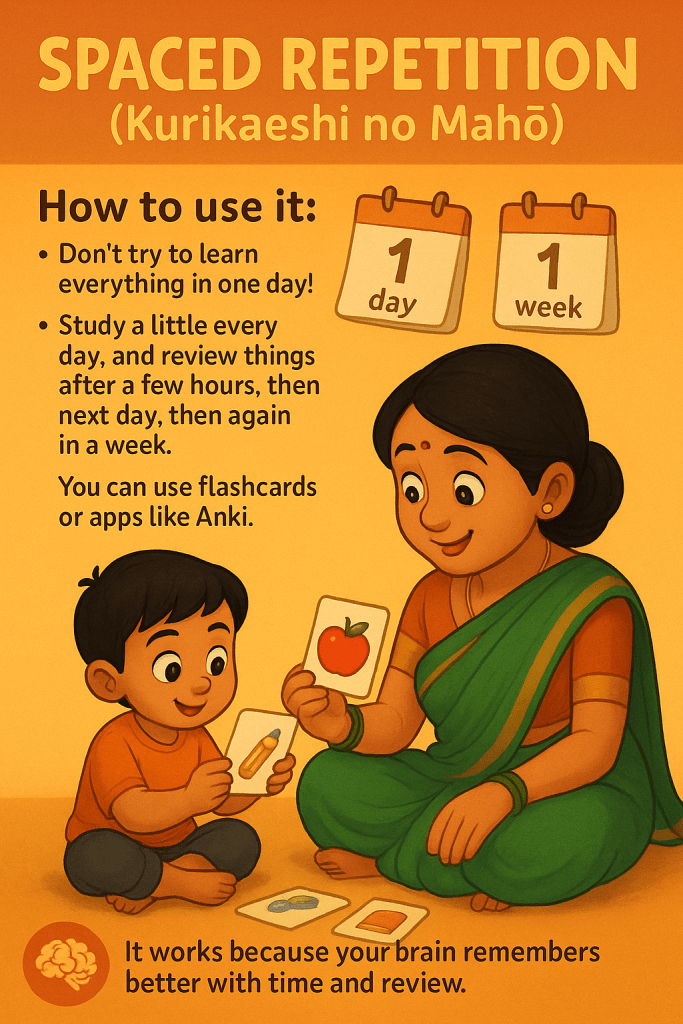
How to use it:
- Don’t try to learn everything in one day!
- Study a little every day, and review things after a few hours, then the next day, then again in a week.
- You can use flashcards or apps like Anki.
🧠 It works because your brain remembers better with time and review.
👨👩👧 For Parents:
- Try these techniques with your child as a fun game.
- Ask them to explain their memory story or show their “memory palace.”
- Turn study time into a bonding activity.


 The Life Navigator